Bidrix guide
How to Write a Winning Freelancer Proposal: 9 Practical Steps
Learn how to write a clear, personalized Freelancer proposal that addresses the client’s real problem, demonstrates relevant experience, and avoids generic copy-paste mistakes.
Why a strong Freelancer proposal matters
A Freelancer proposal is more than a short introduction. It is your first opportunity to show the client that you understand the project, can communicate clearly, and have a practical plan for completing the work.
Many freelancers send proposals that focus mainly on themselves:
- I have several years of experience.
- I am the best person for this project.
- I can complete the work quickly.
- Please message me so we can discuss it.
These statements are easy to write, but they do not help the client understand how you will solve their specific problem.
A stronger proposal begins with the project, not with a long introduction about the freelancer.
The goal of a proposal is not to describe everything about you. Its goal is to make the client confident enough to start a conversation.
1. Read the complete project description
Before writing anything, read the entire project description carefully.
Identify:
- The main result the client wants.
- The technology or skills required.
- Any deadline or delivery expectation.
- The files, access, or information the client will provide.
- Questions that must be answered before work can begin.
- Important instructions included in the description.
Some clients include a specific question or keyword to check whether freelancers have read the complete project. Missing that instruction can make even a well-written proposal look careless.
Do not bid only because the project title matches one of your skills. Confirm that the complete scope is relevant to your experience.
2. Start with the client’s actual problem
Your opening should immediately connect with the project.
Avoid a generic beginning such as:
Hello sir, I am an expert developer and I can do this work perfectly.
Use a more specific opening:
I understand that you need to connect your existing React dashboard to a REST API while keeping the current interface and authentication flow intact.
This opening tells the client that you have read the requirement and understand the expected outcome.
Keep the opening natural. Repeating the complete project description word for word can sound automated.
3. Explain your proposed approach
After identifying the problem, briefly explain how you would handle it.
For example:
- Review the existing code and API documentation.
- Confirm the required endpoints and authentication method.
- Implement the integration in small, testable stages.
- Handle loading, empty, and error states.
- Test the final workflow against the agreed requirements.
- Provide clear deployment or handover notes.
A short plan is often more useful than a long list of unrelated skills. It shows that you can turn the requirement into an organized workflow.
Do not promise a final technical solution when important information is still missing. Clearly state what you need to verify first.
4. Mention only relevant experience
Clients usually care about experience connected to their current project.
Instead of listing every technology you know, select one or two relevant examples:
I recently worked on a dashboard that consumed authenticated REST APIs, handled role-based access, and displayed real-time operational data. That experience is directly relevant to this integration.
If you have a suitable portfolio sample, include one direct link and explain why it is relevant.
Do not send several unrelated portfolio links. The client should not have to search through your complete profile to find evidence.
Never claim experience, results, certifications, or client work that you cannot verify.
5. Ask one useful question
A thoughtful question can demonstrate genuine understanding and make it easier for the client to reply.
Good questions include:
- Is the API documentation complete and available?
- Should the new interface follow the existing design system?
- Do you already have wireframes for the required screens?
- Which payment or authentication provider is currently being used?
- What should happen when the external service is unavailable?
Avoid questions already answered in the project description.
One or two relevant questions are normally enough. A long questionnaire can create unnecessary work for the client before the conversation has started.
6. Keep the proposal concise
A proposal should be detailed enough to be useful but short enough to scan quickly.
A practical structure is:
- One or two sentences showing your understanding.
- Three to six steps explaining your approach.
- One relevant experience example.
- One useful question.
- A simple invitation to continue the conversation.
Remove sentences that do not help the client evaluate your suitability.
Avoid unnecessary claims such as:
- Guaranteed results.
- Unlimited revisions without a defined scope.
- Delivery promises before reviewing the complete requirements.
- Claims that you are the cheapest or best freelancer.
- Income or performance guarantees.
Clear and honest communication creates stronger expectations for both sides.
7. Personalize reusable proposal templates
Templates can save time, but every proposal should be adapted to the project.
A useful template should provide structure rather than finished copy. Before submitting it, update:
- The client’s main requirement.
- The project type.
- Your proposed approach.
- Relevant experience.
- Delivery assumptions.
- Your question for the client.
If the same paragraph could be sent to fifty unrelated projects without modification, it is probably too generic.
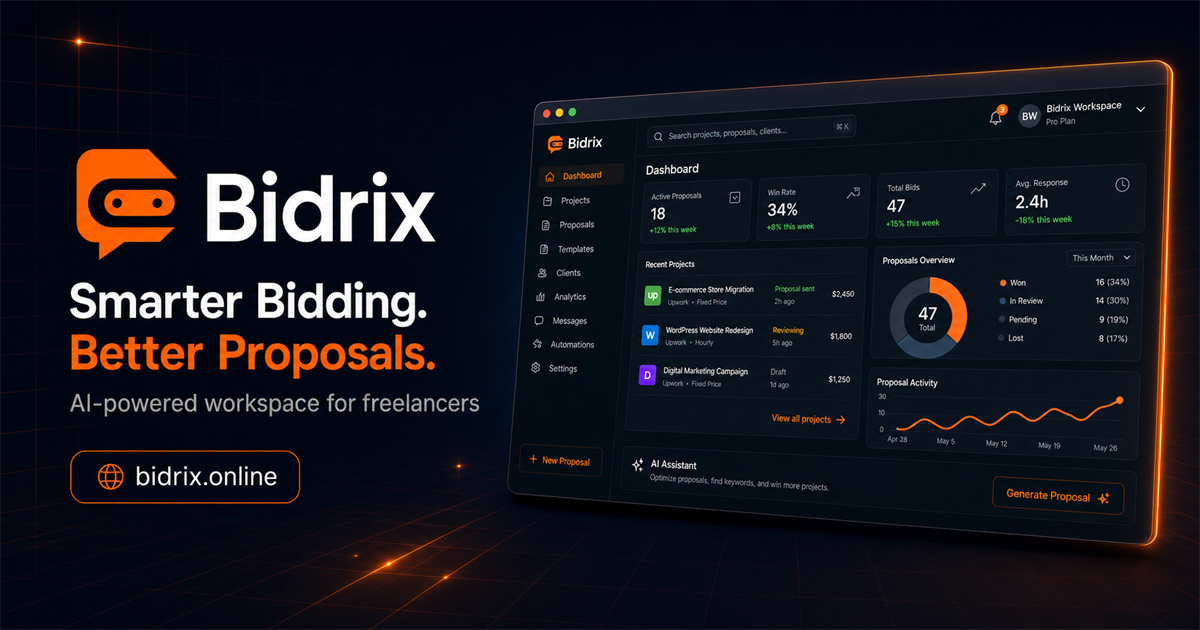
Bidrix allows you to organize reusable proposals and optionally generate editable AI-assisted drafts. These tools should support your judgment, not replace careful project review.
Always verify the final proposal before submitting it.
8. Review price and delivery carefully
Your bid should reflect the actual project scope, complexity, risk, and expected delivery effort.
Before entering an amount, consider:
- How clearly the scope is defined.
- Whether third-party services are involved.
- The amount of testing required.
- Whether design, development, deployment, and support are all included.
- Possible revisions or unknown technical risks.
- Freelancer platform fees and other business costs.
Do not choose a price only to appear cheaper than other bidders.
If the requirements are incomplete, state that your estimate may need confirmation after discussing the missing details.
The delivery period should also be realistic. A short but unreliable promise is less valuable than an achievable schedule.
9. Proofread before submitting
Before submitting your proposal, check:
- Did I address the correct project?
- Is the client’s main requirement clear in my opening?
- Did I explain a realistic approach?
- Is my experience relevant and truthful?
- Did I answer every instruction in the description?
- Is the price appropriate for the scope?
- Are there grammar errors or unfinished placeholders?
- Did I accidentally include another client’s name?
- Is my question useful and specific?
A final review takes little time and can prevent avoidable mistakes.
Example of a stronger Freelancer proposal
Hello,
>
I understand that you need to redesign your existing business website while preserving its current content and improving mobile usability.
>
I would begin by reviewing the existing pages and identifying reusable content. I would then create the responsive page structure, apply a consistent design system, optimize important images, and test the completed website across common screen sizes.
>
I have worked on responsive business websites where existing content and SEO structure had to be preserved during a redesign.
>
Do you already have a preferred visual reference, or should the new design continue using the current brand colors and typography?
>
Thanks,
Your name
This example works because it is specific, easy to scan, and focused on the client’s expected outcome. It does not make unrealistic promises.
Common proposal mistakes to avoid
- Sending the same opening to every client.
- Writing a long personal biography before discussing the project.
- Copying the project description without adding an approach.
- Including irrelevant skills and portfolio samples.
- Offering an unrealistic price or deadline.
- Asking questions already answered by the client.
- Submitting AI-generated text without reviewing it.
- Claiming guaranteed projects, replies, or business results.
- Ignoring platform rules or client instructions.
A simple proposal formula
Use this structure when preparing your next proposal:
- Understanding: Describe the client’s main goal in your own words.
- Approach: Explain the steps you would take.
- Evidence: Mention one relevant experience or portfolio example.
- Clarification: Ask one useful question.
- Next step: Invite the client to continue the discussion.
This formula can be adapted to development, design, writing, marketing, data, and other freelance projects.
Frequently asked questions
Should every Freelancer proposal be completely different?
The core structure can be reused, but the client’s problem, proposed approach, evidence, and questions should be personalized for every relevant project.
Can AI write a Freelancer proposal?
AI can help create a first draft or improve structure, but you should verify every statement. Remove generic language, correct inaccurate assumptions, and ensure the final proposal reflects your real experience.
How long should a proposal be?
There is no universal length. It should be long enough to demonstrate understanding and explain your approach without unnecessary repetition. For many projects, a few focused paragraphs are easier to review than a long generic introduction.
Does a strong proposal guarantee that I will win the project?
No. Client decisions can depend on experience, portfolio quality, availability, price, communication, competition, and other factors. A strong proposal improves clarity but cannot guarantee replies, selection, projects, or income.
Create and manage stronger proposals with Bidrix
Bidrix provides a workspace for discovering relevant projects, organizing reusable proposals, creating editable AI-assisted drafts, and managing controlled bidding workflows.
You remain responsible for reviewing every project, confirming proposal accuracy, selecting an appropriate bid, and following Freelancer.com rules.
Start your 3-day Bidrix free trial or review the available plans.
Start free trial